Tuesday, March 8, 2011
Defensive Ability
I was recently sent a really nice article on statistics in basketball. It captures the history of the movement, but also some current fundamental issues. What it fails to do, however, is address what I will call the "Second Generation" of such analysis in the N.B.A. I fundamentally believe the problem in analysis lies in the type of data we are currently collecting. When one thinks about the box score, one realizes that it is really a type of behavioral coding system. A certain behavior occurs (e.g., player A passes the ball to player B, who quickly makes a shot without dribbling or moving too much) and a tick mark occurs on the box sheet (e.g., player A receives one assist). The problem with the box score as it is currently constituted is that it relies too heavily on discrete, positive outcomes (e.g.., player A receives no credit if player B misses his shot, regardless of the beauty of the pass) and it is relatively unsophisticated. The author in the aforementioned article ends by saying that quantitative analysis will never replace a human watching basketball footage, which is certainly true, because the data analyzed in quantitative analysis are almost entirely based on a human watching basketball footage. What the author fails to see is that this footage can be analyzed (and quantified) in more sophisticated ways, which will (likely) lead to better and more sophisticated models. It will be harder to make such a system than the extant box score (a made shot is a discrete event, but who is to say whether a post-move is "good" or not?) but if made, I believe it will launch us into the Second Generation of basketball analysis. With that in mind, I would like to develop a relatively basic coding system for defensive ability. Something simple, but better than the number of blocks, number of steals, or adjusted +/-. I would like to use this coding system for the rest of the season, see if it correlates with established metrics of good defense (e.g., opponents' shooting percentage, opponents' points/possession, etc.), and to let you, dear readers, to join me for the ride. Any takers?

Monday, March 7, 2011
Hollinger, you win again!
I was intrigued by Hollinger's claim that performance against top teams has nothing to do with playoff success, so I put it to the test. I used a linear regression in which playoff success (total playoff wins) was the dependent variable and win total from the regular season, point differential, and wins against the top three teams were loaded as independent variables. First, win total from the regular season correlated very highly with point differential, but as far as the prediction model went, win total from the regular season outperformed point differential. Lastly, performance against top teams made no difference either way, as Hollinger stated. I would be interested to see this done over a few different years so as to gain more power in the analysis and see if the Hollinger claim holds. Interesting results, but inconclusive.
Saturday, March 5, 2011
Thursday's Top Ten
I know it's not Thursday, except in the middle of Antarctica, but I thought that we should keep the title of our "weekly" feature. Hopefully we'll be getting this up with a far greater frequency in the future.
1. Probably this week's biggest story was the Heat's two huge losses. First, they had Orlando completely dead in the water and then let them go on an 18-0 run. Here's the recap.
2. There's a big time debate in basketball as to what matters: your ability to play well against top teams or how big the point differential is between points your team scores and the points of your opponents? Holistic minded analysts who write about heart and drive tend to think the former matters most, whereas number crunchers stake their reputations on the latter (and, not surprisingly, the numbers usually, but not always back them up). Who's right? Well, both groups could agree the Heat's embarrassing 30 point loss to the Spurs probably means the Spurs are better, WAAAAAY better.

3. Why are the Heat so bad? Well in the Spurs game they were totally outgunned: in fact, Tim Duncan could be seen on the sidelines saying "Game Over" after the first quarter. But in the Magic game, they had a shot at it and ran a play for Bosh to hit a three for the tie. Here's a post suggesting the Heat are less than spectacular in the final moments of a game, contrasting them with the Suns.
4. In non-Heat news, Phil Jackson continued his plot to try and get one of his players to kill him so that he could finally rest in peace and his wife could collect the insurance money (or whatever he's up to), by saying that Ron Artest runs the Lakers' offense better than Kobe.
5. These new Nuggets are pretty awesome. Plus, they have a totally new identity. Just check out the box score for their game against the Bobcats. They collectively scored 120, but no player scored 20. Talk about a 7 headed snake (that's what you were talking about right?).
6. The NBA played it's first game in Europe. Unfortunately for them, the teams playing were the Raptors and the Nets, who had a combined record of 34-88 before suiting up. I can't link to footage of the game (which the Nets won easily) because it's still too painful to see Deron Williams in a Nets' uniform. So instead I'll give you a story about an NBA exec saying he's not sure the NBA will return. I'm sure the people of London (deprived of the Lakers, Spurs, Heat, Magic, Celtics, Bulls, Mavericks, and every other non-Toronto, New Jersey, Cleveland, or Detroit based team) will thank you.

7. My favorite article I read this week involved the New York Times' Nate Silver breaking down actual monetary value of NBA players based on average league salary (and not the artificial price ceiling of the player cap). If I'm reading him correctly, Carmelo signing with the Knicks means that Obama is cruising towards reelection.
8. The final reverberations of the craziest trade deadline ever were felt as the Celtics' signed Troy Murphy, the Mavericks signed Corey Brewer, and the Heat signed Jason Biggs. Here's some analysis of the buy-outs that involved these and some lesser players.
9. In the fictional universe of this post, in which the date is still Thursday, March 3, this messed up situation in Detroit still counts as having sort of happened this week. Man, those halcyon days of the '04 Piston taking on the spoiled Hollywood superstars had to end like this. Hunted down by assassins, Chauncey Billups is the sole survivor of a once great clan. He must figure out who is doing the hunting and avenge his fallen brethren before it's too late. Metaphorically that is. The assassins represent becoming a total unmitigated prick.

10. Finally, in home news. We should have another podcast for you soon. In advance, you're welcome.
1. Probably this week's biggest story was the Heat's two huge losses. First, they had Orlando completely dead in the water and then let them go on an 18-0 run. Here's the recap.
2. There's a big time debate in basketball as to what matters: your ability to play well against top teams or how big the point differential is between points your team scores and the points of your opponents? Holistic minded analysts who write about heart and drive tend to think the former matters most, whereas number crunchers stake their reputations on the latter (and, not surprisingly, the numbers usually, but not always back them up). Who's right? Well, both groups could agree the Heat's embarrassing 30 point loss to the Spurs probably means the Spurs are better, WAAAAAY better.

3. Why are the Heat so bad? Well in the Spurs game they were totally outgunned: in fact, Tim Duncan could be seen on the sidelines saying "Game Over" after the first quarter. But in the Magic game, they had a shot at it and ran a play for Bosh to hit a three for the tie. Here's a post suggesting the Heat are less than spectacular in the final moments of a game, contrasting them with the Suns.
4. In non-Heat news, Phil Jackson continued his plot to try and get one of his players to kill him so that he could finally rest in peace and his wife could collect the insurance money (or whatever he's up to), by saying that Ron Artest runs the Lakers' offense better than Kobe.
5. These new Nuggets are pretty awesome. Plus, they have a totally new identity. Just check out the box score for their game against the Bobcats. They collectively scored 120, but no player scored 20. Talk about a 7 headed snake (that's what you were talking about right?).
6. The NBA played it's first game in Europe. Unfortunately for them, the teams playing were the Raptors and the Nets, who had a combined record of 34-88 before suiting up. I can't link to footage of the game (which the Nets won easily) because it's still too painful to see Deron Williams in a Nets' uniform. So instead I'll give you a story about an NBA exec saying he's not sure the NBA will return. I'm sure the people of London (deprived of the Lakers, Spurs, Heat, Magic, Celtics, Bulls, Mavericks, and every other non-Toronto, New Jersey, Cleveland, or Detroit based team) will thank you.

7. My favorite article I read this week involved the New York Times' Nate Silver breaking down actual monetary value of NBA players based on average league salary (and not the artificial price ceiling of the player cap). If I'm reading him correctly, Carmelo signing with the Knicks means that Obama is cruising towards reelection.
8. The final reverberations of the craziest trade deadline ever were felt as the Celtics' signed Troy Murphy, the Mavericks signed Corey Brewer, and the Heat signed Jason Biggs. Here's some analysis of the buy-outs that involved these and some lesser players.
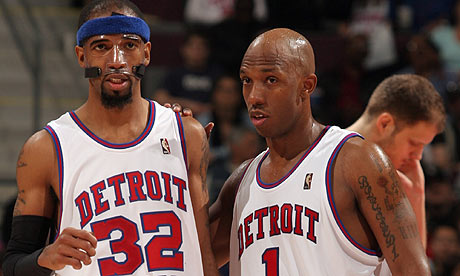
9. In the fictional universe of this post, in which the date is still Thursday, March 3, this messed up situation in Detroit still counts as having sort of happened this week. Man, those halcyon days of the '04 Piston taking on the spoiled Hollywood superstars had to end like this. Hunted down by assassins, Chauncey Billups is the sole survivor of a once great clan. He must figure out who is doing the hunting and avenge his fallen brethren before it's too late. Metaphorically that is. The assassins represent becoming a total unmitigated prick.
10. Finally, in home news. We should have another podcast for you soon. In advance, you're welcome.
Sunday, February 27, 2011
TGRTNS Podcast
Thursday, February 24, 2011
Careful, now...
As Jazz fans, we are all devastated to see Deron go. We have watched him grow and flourish. He has gone from absurdly underrated to league-wide appreciation under our watchful eyes. And now he is gone. It is too bad, but as a fan and as a Utah native, I will still cheer for the Jazz. To me, the team is not constructed of any number of specific players or coaches, but rather as a collection of those two as well as fans, memories, perceptions, and emotions. No removal of any one piece or of any combination of pieces changes that meaning, which spans across multiple dimensions and is manifested in different materials.
One concern I have is the backlash against Williams. Was he frustrating at times? Certainly. Was he uncomfortably close to the Sloan retirement? Yes. He was also, however, a Jazz player and a champion at heart. He had a great relationship with fans, tried hard, was incredibly competitive, and did not mix with national media. What is more Jazz than that? Let us remember the good times and not blame him for a trade that he did not ask for. Furthermore, I do not like the tone of many rebukes aimed at Deron. From slcdunk.com, the premier Jazz blog for content, there have been a number of posts that discuss putting Deron in his place, demanding that he respect the front office and the state of Utah and so forth. These paint him as some LeBron character, who held the franchise hostage. That is absurd and revisionist. It is a convenient narrative to paint over a painful reality. Kevin O'Connor is actually very mediocre. He drafts horribly in first rounds, and drafting is the only thing that has made the Jazz good in the past. Furthermore, he does not take responsibility in interviews when the team plays poorly and instead blames coaching and player effort. None of this is very Jazz like. It was his decision to shop Deron and it was he who called Miller to push the trade. So please leave Deron out of it.
I also will not stand for what I consider to be racial undertones throughout this process. Forcing Deron to show respect to the state and to respect a front office (one that has not earned any respect from my perspective) and other quips of this nature seem to me echoes of an earlier and uglier time in Jazz history in which white players were loved for their hard work, loyalty, team spirit, and dedication, and black players were begrudgingly accepted due to their natural basketball talents. LeBron's backlash was deserved to some extent, but not the racial slurs that people threw at him via twitter. Deron's trade was neither self-initiated, even if that narrative is more comfortable to deal with, nor was it due to some characteristics in which he did not show proper respect to the state or to management. It was an unfortunate mismanagement that led us here and let us remember history as it actually happened.
Deron Williams Trade: What Exactly Am I Rooting For?
This Deron Williams trade left me even more shell shocked than Sloan's retirement. I spent the day avoiding thinking about it, trying alternatively to convince myself of and talk myself out of the notion that it was a prank, and listening to break up music. I spoke to a few friends about it and they essentially said the same thing. This is what sports is all about. You're being tested. They weren't going to win a championship anyway. And, the most common refrain, you have to stay loyal to the team.
At the start of this season things were exciting for us Jazz fans. A lot of the team had left during trades and free agency, and we had signed a lot of new players. This season was wide open. We were probably going to be worse than we had been, but maybe we would be as good, and there was a slim chance we would be better. Things started well. Then we hit a wall. Our team slumped. And slumped and slumped. Although I made excuses for a while, it became apparent to me that this team was just no good. At least we still had Jerry Sloan and Deron Williams, though. Then Sloan quit. This was distressing, but it had to come. At some point, the guy was just going to give out. And it just happened this year.
But trading Williams was terrible, terrible news. The Utah Jazz were a team with one amazing player, a top ten player who was arguably the best at his position -- something that is very, very hard to come by -- and a bunch of others below league replacement. That wasn't fated, however. The mediocre cast that surrounded Williams was the product of a number of bad decisions made by our General Manager Kevin O'Connor. While he probably could never save Boozer, he could have tried to trade him two years ago when it became obvious he was leaving in free agency. He could have avoided giving away Eric Manor and Ronnie Brewer, or if he had to give them away, he could have tried to pair them with Kirilenko's bloated contract, so as to free up some cap space. He could have made an effort to keep Korver and Matthews, but he didn't. He didn't do any of those things. And when things blew up, he tried to rebuild on the fly. And when that failed, Williams and Sloan both fell on the sword for him.
There is now very little that connects the Utah Jazz as it's currently constituted with the team I rooted for last year, or as a child. The only major connecting element to what came before and what currently exists are the General Manager and the Owner (even here, the beloved Larry H. Miller is gone). Everything has changed. The coaching staff is different. The players are different. Even the uniforms and team logo are different. Kevin O'Connor and Greg Miller are the only connecting elements. One of them can't do his job. The other called Deron Williams after the story had already leaked to ESPN to inform him that he wouldn't be playing for the team any more. He didn't ask for his input. He didn't give him any warning. He just told him to pack his stuff. That phone call lasted 30 seconds. I realize I'm not privy to what went on behind closed doors and that Williams very well might have left anyway. But none of that excuses that kind of behavior. That is cold blooded and cruel. Worse than what LeBron did to Cleveland.
Rooting for the Jazz boils down to rooting for Miller and O'Connor, as they are the only two Jazzmen (with minor exceptions) who have any kind of established identities as Jazzmen. One is incompetent at his job. The other ruthless, or, best case scenario, an unfeeling buffoon. Why should I root for them? Why should I root for this team?
Friday, February 11, 2011
ESPN's Version of Williams' Part In Sloan's Resignation
I've read enough stories to have a pretty good sense of what happened between Sloan and the Jazz. He clashed a lot with Williams, they had a rocky relationship, and it got to the point where it was no longer worth it for him. You could say that the whole ordeal was Williams' fault, sort of. But what you can't say is that Williams forced Sloan out by going to the management. That is, unless you're ESPN. If you're ESPN you can conjecture about that in multiple stories, none of which site a source in Utah (though they may find sources who say things like, "99% of the players were happy," while an indictment of Williams, it doesn't follow from that source that Williams went to management and said, "Him or me"). Yet nevertheless, columnist after columnist has taken to the website and the idiot box to offer this conjecture. Last night they printed some e-mails from Jazz fans that threaten Williams with being booed and the like. Why this total disregard for the truth (or at the very best, wild, damaging speculation)? Because it makes good copy. As I think they discovered with the LBJ situation, uppity sports star doesn't know his place, is a headline everybody can get behind (did he push Spoelstra, did he wait outside of Spoelstra's house with a knife? we have no reason to think so, but what if he did?). Pretty ridiculous and disgusting. Pretty stupid, too. There's a reason sport has a reputation as, how shall I put this, less than brilliant. Can you imagine this sort of thing in the New York Times? Did Obama help plan the crackdown on Egyptian protesters? A source close to the White House said, "The administration is upset about what's happening in Egypt," so we have proof. Sloan leaving is a sad event made pathetic by this bullshit. "Reporting" pure conjecture is not really reporting. Gleefully choosing the most dramatic story for its drama is not news work, its gossip. I thought sports writers got into the game because of their love of athleticism, doubtless that's true for many. But some just couldn't get jobs at the National Enquirer.
Subscribe to:
Posts (Atom)

