"There's a curse that comes with limitless potential: Everyone judges you against only that limitless potential." -Bill Simmons
Basketball is the only sport where history is written not only as it unfolds, but in a great many cases, before it has begun to unfold at all. Only on a lacquered floor could a superstar like Dirk Nowitski go comparatively unnoticed for the past five years. The only explanation is that the Teutonic Furor had lost his only chance to grab the ring in 2006, and that whole Golden State unpleasantness the year after. Now that Dirk is back in the spotlight, he's Larry Freaking Bird. Whether that's true or not, I don't care to say - but we can all agree Dirk has not gotten significantly better in the course of this 2010-2011 campaign. He's simply closer to the microphone.
Gregg Doyel controversially asked Lebron James if he was shrinking in the 4th quarter, the place where "superstars become superstars". This loaded question and its meaningless response aside, is Lebron James a superstar? He has won MVP, that's true, he has played in the finals (although, when the best player on his own team, he has never won a finals game) and he has guided teams to 60 win seasons. Lebron has taken a backseat in these past two games, compiling a meager 25 points with a respectable 18 assists, letting the alpha dog Wade try to beat the Mavericks for the second time in his career. All the games have been close, and Miami currently has two home games left in this best-of-three tilt. They're in a position to win, and every article you read is about how James is "shrinking."
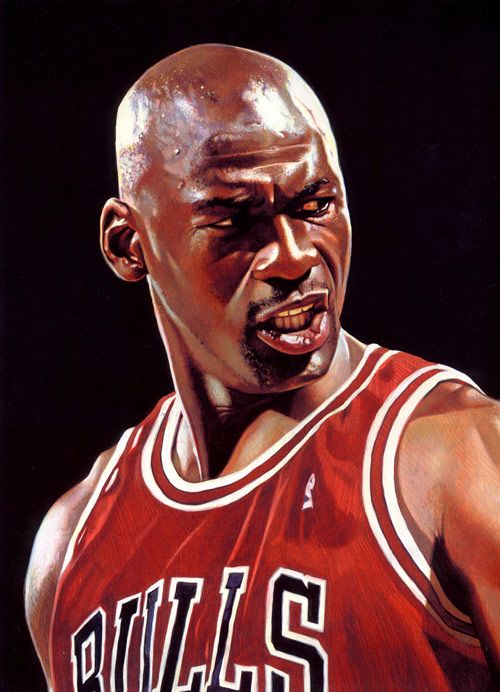
What is he shrinking from? Michael Jordan, the greatest competitor of all time. Michael Jordan was not the greatest athlete of all time, though he may have had the most accomplished career and may have dominated his sport more than anyone besides perhaps Tiger Woods has ever dominated a sport. Michael Jordan was a competitor. Lebron James is an athlete. Michael Jordan could take the pressure and the team on his back and beat you, flat out, no matter what, any night of his professional life. Scouts and sportswriters saw a 15-year-old Lebron James, already heavier and taller than Jordan had ever been, and said "what if...". In doing this, they pretty much guaranteed that James would never live up to their ridiculous expectations.
No one said after Albert Pujols rookie year "this guy is not only the greatest right-handed hitter of all time, he'll probably end up having a better career than Babe Ruth." If people thought Peyton Manning was the best quarterback they'd seen coming out of college since Elway, no one dared say aloud, on national television, they thought Manning would surpass #7's records. Sure, it was important that those two guys, tops in their sport, win titles, which they did (although Peyton's took a while), but no one was saying "just wait 'til he's won 6, then we can really start this debate!"
When James was draft in 2003, basketball was in something of a lull. Jordan was long gone, Shaq and Kobe were beginning to tussle, and the only real one-man show was Allen Iverson. The writers needed a savior, someone we could watch in our time and claim as the greatest and, not surprisingly, they chose the 6'8 kid out of Akron with wide receiver speed. And it wasn't just enough that he win all those titles, he had to do it with a smile on his face and a cloud of chalk above his head. There's a lot more of that mean, Hall-of-Fame-induction-speech side of Jordan in Kobe Bryant than there ever was or will be in Lebron James.
They ground him down so much, made him crave a championship so much, that he ultimately realized his own limitations, and was forced to partner with Wade, rather than staying in Cleveland and living the unexamined life. No matter how this series ends up, we've all learned one thing: Lebron was never the man we thought he was. Or wanted him to be.
Wednesday, June 8, 2011
Friday, June 3, 2011
We're back!
Here at True Greatness, we were so downtrodden and defeated after Deron Williams and Kendrick Perkins were traded away that writing about basketball became an aversive and distasteful undertaking. We are officially back. Two very brief thoughts about NBA basketball as it stands today:
1. KOC- My biggest issue with him is not that he is a bad general manager overall. In fact, a lot of short term fixes that he has done are quite good (e.g. trading for Kyle Korver, stealing Boozer away from the Cavs, seeing talent in Wesley Matthews, snagging big Al out of thin air, etc.) My main complaint is that he appears to have no long-term vision. Are the Jazz rebuilding, or are the competing to be the 8th seed to lose to the Thunder in 5? Is Devin Harris a Jazz man for life, or a place holder until someone better shows up? My personal plan would be to trade up in the draft and get either Williams or Irving. Get rid of veterans who cannot turn us into contenders (sorry, CJ). Rebuild and give the new guys some playing time. And do it all with purpose and vision. You aren't the worst, KOC. You are far from it. But you need to learn to look to the future, not just react to the present.
2. I would also like to officially endorse the True Greatness pick for the finals: Go Mavs!
That's it for now. Hopefully we will be back with more soon.
Wednesday, April 13, 2011
Michael Jordan: Great Man
This is all a pretty good analysis, as far as it goes, but it doesn't really capture the truth. Simply put, a lot of guys are really competitive pricks. And a lot of them have insane basketball talent. The best example of one of these is Kobe Bryant, who yesterday, called a ref a gay slur that refers to the pile of sticks used to burn gay people in the past. Kobe was visibly upset after getting a technical foul called on him. He stormed to the bench, nearly punched his teammate, threw a towel, and then yelled out to the ref. Basically he threw a nationally televised fit. Here's some video. Today he gave a milquetoast apology saying what he said wasn't meant to be taken literally (the guy isn't literally a pile of sticks, I guess) and that he didn't mean to offend anyone. Some (my good friend representing them) think this is just the kind of thing that Michael Jordan would do if he were around today. They argue that basketball players, or at least the hyper competitive kind, are small minded, quick to fly off the handle, and can get pretty offensive and pretty scary quite rapidly. If we have no examples from Jordan's actual career of incidents like this one it is because the media have advanced to such a point that everything is now covered. There is some truth in the idea that today's players face increased media scrutiny. Still, we have a love of heroes. LeBron was one up until the decision, where most of the criticism coming at him was pretty lame and was squashed by people in the media themselves. LeBron, up until the decision, had something else in common with Jordan too. Something that Kobe lacks: he was a deft handler of his image.
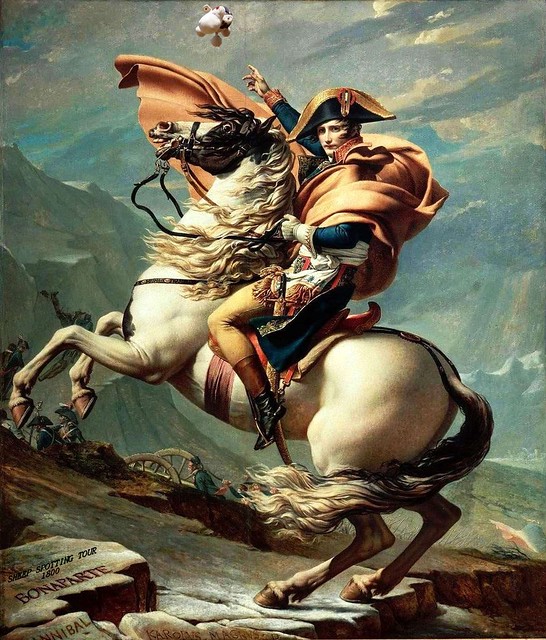
I think the forgotten piece in the Jordan puzzle (or a forgotten piece, as we'll never fully recreate the man) was his ability to handle his image; to make his own story into something that we would root for above and beyond the game. He has oft been mocked for saying that he wouldn't endorse a Democratic candidate because "Republicans buy shoes too," but this mockery totally misses the point of the man and his comment. All great men and women, from Catherine the Great and Napoleon Bonaparte to Teddy Roosevelt to Mahatma Gandhi knew how to spin their own legacy. They were, each one of them, shameless self promoters. They also knew, almost instinctively how to blend their stories into larger themes and how to rewrite their pasts so that they fit the day's narrative and appealed to a broad spectrum of people. A huge part of Napoleon's legacy comes from his memoirs, written when he was imprisoned, which reinterpret his rule through the prism of pro-republicanism and freedom loving grandness. I believe that all the great persons of history have either done this, or had it done for them by those who followed (which may be the case with Leonardo Da Vinci and William Shakespeare). How else could their trials and tribulations remain timeless, if they didn't change to speak to each time that considered them?
Michael Jordan did the same, albeit on a much smaller scale. In his youth he was the hotshot scorer. The dunker and leaper with unparalleled athletic ability.
Then he was the hero valiantly fighting a losing battle against superior teams from Detroit and Boston (it was a sole man vs. the hordes, the same concept as 300).
Then his story changed again, he became on top of the world, the best ever. He dunked less, but he was just as murderous for his passing and shooting abilities.
Then he was too good for basketball even. Then he returned, world weary, like the man going in for just one last heist. He was still on top of the world, but he dominated through sheer will power instead of talent. He relied more on teammates and played defense to win.
Of course each of these transitions was punctuated with the appropriate spin and commercials. Jordan launched Space Jam at the height of his (nearly) final career stage (then he came back for the Wizards, spinning himself both as the returned hero and now wise master).
The thing is, none of these stages of Jordan are really discrete. He could dunk against the Jazz and he could shoot, pass, and play D back in his North Carolina days. He chose to emphasize different aspects of his game and hinted to the media what needed emphasis so as to fit his personal narrative into what was big at the time. The media shaped a lot of this on its own, but Jordan was smart enough to take their cues and play along. His ability to appeal to so many different people in so many different ways made him a wonderful basketball player, but also a great man. I'm still in awe that I lived during his time and got to witness his legend unfold first hand.
Every great person has the talent and skills that inflame our imaginations, that lead us to speculate about them and even worship them. What separates the great from the merely talented is the ability to shift their personal stories into the realm of the mythic. Michael Jordan would have never thrown a fit like Kobe, not because he wasn't as big of an asshole, but because that would have marred the Michael Jordan legend. He craved not only Ws but a legacy as well; his ambition was big enough that it contained his name in the history books, not merely a list of the number of rings he won. He is still working on it, still trying to prove himself great, this time as the builder and runner of a basketball team. The kind of largeness that Jordan sought is so big that Kobe has no clue it exists. He stands next to it in all his petty smallness, not knowing the chill he feels is from a colossus' shadow blocking out the sun. As he enters into the playoffs, obsessed with tying Jordan's ring record and putting his name in the conversation for best basketball player ever to live, he is completely unaware that he has already lost.
Monday, April 11, 2011
Good-Bye To All That: So Long Free Darko
I have been pretty far away from basketball for a while -- there have been other things going on in my life, and it always becomes hard to watch when your team sucks and it is obviously not going to get any better for a while. So it came as a bit of a shock to me when I found out just now that freedarko is no more. I have a somewhat fraught relationship with the blog. I deeply admire its beautiful artwork, the creativity of its post subjects, and some of the many brilliant things it has done for basketball (popularizing and epitomizing the basketball blogging culture is just the most obvious). I also hated the blog at times. Mostly this was out of jealousy and a certain iconoclastic position I've always taken -- I always do the Nietzchean inversion of morals thing and determine that any given popular thing is bad precisely for the reasons its proponents think its good (mostly, this is probably just jealousy). But in addition to reasons of envy, the freedarko site has frequently offended me in aesthetic ways. The writing is mannered in a particular style that I find pretty obnoxious, lazy, and much less smart than it takes itself to be. Very frequently sentences are packed with too many ideas and, instead of appearing deep or something, they seem like the results of muddled thinking that didn't reveal anything at all. Reading this stuff was pretty frustrating. It seemed more an excuse to name drop and show of the eclecticism of its creator's interests than to inform or engage with the reader. If only they had an editor, I often opined. This sort of writing -- similar to that which can be found at pitchfork, which was brilliantly lampooned by David Cross -- seemed to represent the worst of do it yourself internet journalism: it was out of touch, masturbatory, and off putting. It exemplified, at least to me, HL Mencken's dictum that people were bad writers because they were bad thinkers (I'm not above name dropping and self congratulatory masturbation). Then there were the images: that crazy lolzcats internet aesthetic where everything is as grainy and unrelated to the article as possible, while appearing designed to leave the viewer with a feeling of queasiness and/or general disgust (we too, have not always been above this).
That stuff has annoyed me at times, but it has also made freedarko a unique website. One that really felt better suited to its medium than almost any other. The writers, particularly Shoals, in addition to annoying me with their individual sentences and ideas, were also courageous. I mean that in the highest sense it can be applied to an activity done from the safety of your own bed (note: not that courageous). They were unafraid of tackling any issue no matter how controversial or inane. And a lot of the ill-formed writing I mentioned above (articles comparing Jordan opponents to forgotten genesis games; ranking stadiums by horror film appeal; what have you) were often the result of creativity pushed as far as it would go. Writers on freedarko took on issues of real substance. I am incredibly grateful for their attempts to deal with race in the NBA, and for their insistence on challenging the received wisdom, often showing the arrogant and reactionary assumptions it was based on. These are issues that are incredibly important for anyone seriously interested in sports. And they are anathema to many major sports outlets where, much like in the NBA itself, what matters is keeping everyone happy and not upsetting the boat. Freedarko offered a break from that kind of thinking. It also offered a break from the strict confines of sports journalism, providing essays that were surprising, funny, thought provoking, and delightfully weird. It was often a romp to check out their site. I'll miss that irreverent fun.
The good news is that what freedarko started lives on in sites too numerous to count. They got in when the getting was good. They popularized blogging about basketball and forever defined what its aesthetic would look like. If I may steal a line from another faceless basketball blog, they really were the Velvet Underground of this enterprise. As long as semi-articulate, over educated people are spending too much of their time writing about basketball and giving their content away free, freedarko will live on. The joke that informs the blog's title has already come to pass: Darko is a semi-important part on an NBA team; he is freed (unless the blog was asking for Milicic to be freed from his physical imprisonment on Earth through assasination, which is pretty uncool, I think) from his former unhappiness. It's time Shoals and his coterie of writers are freed along with him; no longer fettered to the format they developed, which must have become, at least a little bit, restricting after six years, they can begin to exert their influence elsewhere. They'll go on to do bigger and better things, having left their mark on all of us who read them (I read Shoals in the Atlantic a few weeks ago, which blew my mind). This blog and many others wouldn't exist without their pioneering work, for which I want to say thanks. So... be free Darkos, go forth and prosper. I wish you the best. Thanks for the memories.
Tuesday, March 8, 2011
Defensive Ability
I was recently sent a really nice article on statistics in basketball. It captures the history of the movement, but also some current fundamental issues. What it fails to do, however, is address what I will call the "Second Generation" of such analysis in the N.B.A. I fundamentally believe the problem in analysis lies in the type of data we are currently collecting. When one thinks about the box score, one realizes that it is really a type of behavioral coding system. A certain behavior occurs (e.g., player A passes the ball to player B, who quickly makes a shot without dribbling or moving too much) and a tick mark occurs on the box sheet (e.g., player A receives one assist). The problem with the box score as it is currently constituted is that it relies too heavily on discrete, positive outcomes (e.g.., player A receives no credit if player B misses his shot, regardless of the beauty of the pass) and it is relatively unsophisticated. The author in the aforementioned article ends by saying that quantitative analysis will never replace a human watching basketball footage, which is certainly true, because the data analyzed in quantitative analysis are almost entirely based on a human watching basketball footage. What the author fails to see is that this footage can be analyzed (and quantified) in more sophisticated ways, which will (likely) lead to better and more sophisticated models. It will be harder to make such a system than the extant box score (a made shot is a discrete event, but who is to say whether a post-move is "good" or not?) but if made, I believe it will launch us into the Second Generation of basketball analysis. With that in mind, I would like to develop a relatively basic coding system for defensive ability. Something simple, but better than the number of blocks, number of steals, or adjusted +/-. I would like to use this coding system for the rest of the season, see if it correlates with established metrics of good defense (e.g., opponents' shooting percentage, opponents' points/possession, etc.), and to let you, dear readers, to join me for the ride. Any takers?
Monday, March 7, 2011
Hollinger, you win again!
I was intrigued by Hollinger's claim that performance against top teams has nothing to do with playoff success, so I put it to the test. I used a linear regression in which playoff success (total playoff wins) was the dependent variable and win total from the regular season, point differential, and wins against the top three teams were loaded as independent variables. First, win total from the regular season correlated very highly with point differential, but as far as the prediction model went, win total from the regular season outperformed point differential. Lastly, performance against top teams made no difference either way, as Hollinger stated. I would be interested to see this done over a few different years so as to gain more power in the analysis and see if the Hollinger claim holds. Interesting results, but inconclusive.
Saturday, March 5, 2011
Thursday's Top Ten
I know it's not Thursday, except in the middle of Antarctica, but I thought that we should keep the title of our "weekly" feature. Hopefully we'll be getting this up with a far greater frequency in the future.
1. Probably this week's biggest story was the Heat's two huge losses. First, they had Orlando completely dead in the water and then let them go on an 18-0 run. Here's the recap.
2. There's a big time debate in basketball as to what matters: your ability to play well against top teams or how big the point differential is between points your team scores and the points of your opponents? Holistic minded analysts who write about heart and drive tend to think the former matters most, whereas number crunchers stake their reputations on the latter (and, not surprisingly, the numbers usually, but not always back them up). Who's right? Well, both groups could agree the Heat's embarrassing 30 point loss to the Spurs probably means the Spurs are better, WAAAAAY better.

3. Why are the Heat so bad? Well in the Spurs game they were totally outgunned: in fact, Tim Duncan could be seen on the sidelines saying "Game Over" after the first quarter. But in the Magic game, they had a shot at it and ran a play for Bosh to hit a three for the tie. Here's a post suggesting the Heat are less than spectacular in the final moments of a game, contrasting them with the Suns.
4. In non-Heat news, Phil Jackson continued his plot to try and get one of his players to kill him so that he could finally rest in peace and his wife could collect the insurance money (or whatever he's up to), by saying that Ron Artest runs the Lakers' offense better than Kobe.
5. These new Nuggets are pretty awesome. Plus, they have a totally new identity. Just check out the box score for their game against the Bobcats. They collectively scored 120, but no player scored 20. Talk about a 7 headed snake (that's what you were talking about right?).
6. The NBA played it's first game in Europe. Unfortunately for them, the teams playing were the Raptors and the Nets, who had a combined record of 34-88 before suiting up. I can't link to footage of the game (which the Nets won easily) because it's still too painful to see Deron Williams in a Nets' uniform. So instead I'll give you a story about an NBA exec saying he's not sure the NBA will return. I'm sure the people of London (deprived of the Lakers, Spurs, Heat, Magic, Celtics, Bulls, Mavericks, and every other non-Toronto, New Jersey, Cleveland, or Detroit based team) will thank you.

7. My favorite article I read this week involved the New York Times' Nate Silver breaking down actual monetary value of NBA players based on average league salary (and not the artificial price ceiling of the player cap). If I'm reading him correctly, Carmelo signing with the Knicks means that Obama is cruising towards reelection.
8. The final reverberations of the craziest trade deadline ever were felt as the Celtics' signed Troy Murphy, the Mavericks signed Corey Brewer, and the Heat signed Jason Biggs. Here's some analysis of the buy-outs that involved these and some lesser players.
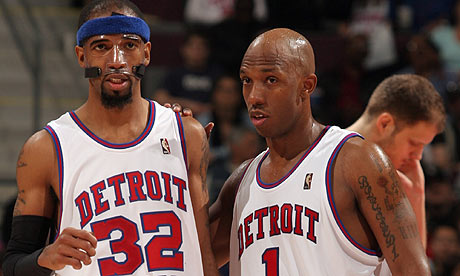
9. In the fictional universe of this post, in which the date is still Thursday, March 3, this messed up situation in Detroit still counts as having sort of happened this week. Man, those halcyon days of the '04 Piston taking on the spoiled Hollywood superstars had to end like this. Hunted down by assassins, Chauncey Billups is the sole survivor of a once great clan. He must figure out who is doing the hunting and avenge his fallen brethren before it's too late. Metaphorically that is. The assassins represent becoming a total unmitigated prick.

10. Finally, in home news. We should have another podcast for you soon. In advance, you're welcome.
1. Probably this week's biggest story was the Heat's two huge losses. First, they had Orlando completely dead in the water and then let them go on an 18-0 run. Here's the recap.
2. There's a big time debate in basketball as to what matters: your ability to play well against top teams or how big the point differential is between points your team scores and the points of your opponents? Holistic minded analysts who write about heart and drive tend to think the former matters most, whereas number crunchers stake their reputations on the latter (and, not surprisingly, the numbers usually, but not always back them up). Who's right? Well, both groups could agree the Heat's embarrassing 30 point loss to the Spurs probably means the Spurs are better, WAAAAAY better.
3. Why are the Heat so bad? Well in the Spurs game they were totally outgunned: in fact, Tim Duncan could be seen on the sidelines saying "Game Over" after the first quarter. But in the Magic game, they had a shot at it and ran a play for Bosh to hit a three for the tie. Here's a post suggesting the Heat are less than spectacular in the final moments of a game, contrasting them with the Suns.
4. In non-Heat news, Phil Jackson continued his plot to try and get one of his players to kill him so that he could finally rest in peace and his wife could collect the insurance money (or whatever he's up to), by saying that Ron Artest runs the Lakers' offense better than Kobe.
5. These new Nuggets are pretty awesome. Plus, they have a totally new identity. Just check out the box score for their game against the Bobcats. They collectively scored 120, but no player scored 20. Talk about a 7 headed snake (that's what you were talking about right?).
6. The NBA played it's first game in Europe. Unfortunately for them, the teams playing were the Raptors and the Nets, who had a combined record of 34-88 before suiting up. I can't link to footage of the game (which the Nets won easily) because it's still too painful to see Deron Williams in a Nets' uniform. So instead I'll give you a story about an NBA exec saying he's not sure the NBA will return. I'm sure the people of London (deprived of the Lakers, Spurs, Heat, Magic, Celtics, Bulls, Mavericks, and every other non-Toronto, New Jersey, Cleveland, or Detroit based team) will thank you.
7. My favorite article I read this week involved the New York Times' Nate Silver breaking down actual monetary value of NBA players based on average league salary (and not the artificial price ceiling of the player cap). If I'm reading him correctly, Carmelo signing with the Knicks means that Obama is cruising towards reelection.
8. The final reverberations of the craziest trade deadline ever were felt as the Celtics' signed Troy Murphy, the Mavericks signed Corey Brewer, and the Heat signed Jason Biggs. Here's some analysis of the buy-outs that involved these and some lesser players.
9. In the fictional universe of this post, in which the date is still Thursday, March 3, this messed up situation in Detroit still counts as having sort of happened this week. Man, those halcyon days of the '04 Piston taking on the spoiled Hollywood superstars had to end like this. Hunted down by assassins, Chauncey Billups is the sole survivor of a once great clan. He must figure out who is doing the hunting and avenge his fallen brethren before it's too late. Metaphorically that is. The assassins represent becoming a total unmitigated prick.
10. Finally, in home news. We should have another podcast for you soon. In advance, you're welcome.
Subscribe to:
Posts (Atom)